
A maintenance model developed for one machine or plant may not transfer reliably to another. Beverage facilities operate different equipment models, production speeds, recipes, cleaning cycles, and maintenance practices. Failure events can be rare, and work-order descriptions may not identify the precise failure mode. These conditions make it difficult to train and validate predictive maintenance methods using large, consistently labeled datasets.
Equipment Health, Inspection and Quality Intelligence Research for Beverage Production
Beverage production equipment and product-quality decisions are often made with incomplete failure histories, inconsistent inspection records, or too few examples of known defects. This research program examines methods for learning from the evidence plants already collect, combining relevant measurements, and testing whether AI-supported findings improve maintenance and quality decisions under representative operating conditions.
The scope includes production and packaging assets such as pumps, motors, gearboxes, compressors, chillers, process vessels, heat exchangers, pasteurizers, carbonators, syrup systems, fillers, cappers, labelers, conveyors, and bottle or can handling equipment. It also considers the process conditions that influence beverage quality, including flow, pressure, temperature, fill level, carbonation, product concentration, and packaging integrity. The appropriate measurements depend on the equipment, product, process stage, and plant's existing instrumentation.
Research Focus: Equipment Health and Predictive Maintenance
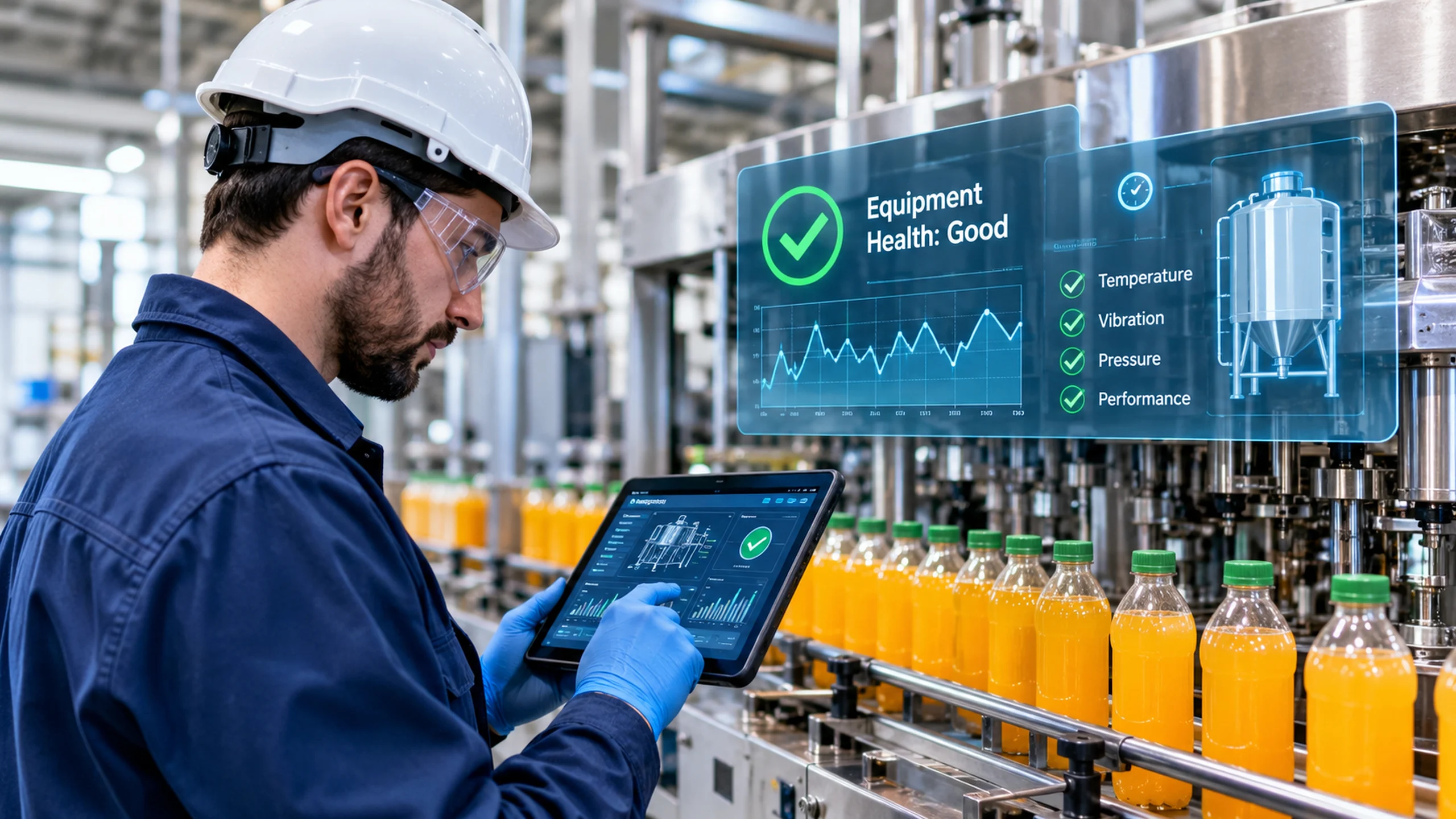
Research questions include which operating signals provide useful evidence of developing equipment faults, how models can be adapted across similar machines, and how uncertainty should affect a maintenance recommendation. Candidate inputs include vibration, temperature, motor current, pressure, flow, acoustic measurements, operating speed, product or recipe context, start-stop cycles, cleaning-in-place (CIP) cycles, alarms, maintenance history, and operator observations.
Candidate methods include equipment-specific baselines, anomaly detection, fault classification where labels are adequate, and transfer learning across related assets. Models should account for operating mode and production context rather than treating every change in a sensor reading as a fault. Maintenance records and technician-confirmed findings can provide labels, but their completeness and consistency must be assessed before model training.
The research objective is not to replace condition-based inspections or maintenance expertise. It is to test whether combining sensor trends, operating context, and documented maintenance evidence can help teams identify equipment that warrants closer inspection, estimate the urgency of follow-up, and explain the evidence behind a suggested priority.
Research Focus: Multimodal Inspection and Defect Detection
Beverage inspection tasks involve different defect types, surfaces, materials, and process stages. A single camera or sensor may not provide enough evidence to distinguish a true defect from glare, condensation, label variation, bottle color, or normal product movement. Research into multimodal inspection examines whether complementary sensing methods can improve detection while preserving a clear record of why an item or process condition was flagged.
Potential inspection settings include empty-container inspection before filling, fill-level and closure checks, label and date-code verification, package integrity review, and inspection of accessible equipment surfaces or components. Candidate inputs may include visible-light imaging, controlled illumination, thermal imaging, acoustic measurements, and relevant process-sensor data. Each method requires a defined inspection target, suitable placement, and test conditions that reflect line speed, vibration, moisture, reflections, product variation, and sanitation requirements.
Research questions include whether combining image features with process measurements reduces missed defects, how the system should handle uncertain or conflicting sensor results, and how performance changes when the product, container, line speed, lighting, or equipment configuration changes. Candidate methods include rule-based inspection baselines, machine-vision classification or object detection, anomaly detection for scarce defect classes, and sensor fusion where the data are time-aligned and refer to the same product or asset.
Inspection output should distinguish a confirmed nonconformance from a low-confidence observation that requires human review. Where a plant uses a validated reject, hold, or diversion mechanism, any connection between an AI finding and that mechanism requires a separately assessed interface, authorization, and verification process. Research results should not be interpreted as food-safety certification or proof that a process control is effective.
Research Focus: Process Quality Prediction and Defect Investigation
Product quality can be affected by interactions among ingredients, process settings, equipment condition, and packaging operations. A quality deviation may appear at the end of a line even though its contributing conditions occurred earlier in water treatment, syrup preparation, blending, carbonation, thermal processing, filling, or packaging. Research can examine whether process histories and inspection records help identify patterns associated with a quality deviation and narrow the investigation of likely causes.
Potential data sources include laboratory and at-line test results, batch and recipe records, temperature and pressure histories, flow and dosing records, fill measurements, carbonation readings, equipment alarms, changeover information, cleaning records, and packaging inspection results. Candidate prediction targets should be defined with quality personnel and tied to documented acceptance criteria. Depending on the beverage and process, these may include variation in product concentration, carbonation, fill quantity, appearance, closure condition, or package presentation.
The research questions are whether process context improves prediction over existing statistical or rule-based baselines, which variables contribute consistently to a deviation, and how to avoid treating correlation as proof of root cause. Candidate methods include multivariate process analysis, supervised prediction where representative labels exist, anomaly detection, and explainability techniques that help investigators review influential inputs. A model can prioritize investigation, but causal conclusions require process knowledge and appropriately designed follow-up tests.
Research Focus: Structural Health and Facility Condition
Structural health assessment is relevant where beverage production depends on the condition of tanks and their supports, elevated pipework, platforms, floors, foundations, or utility structures. The research scope should be limited to assets and facility conditions that have a clear operational or inspection need. Geotechnical assessment is not a default beverage-production use case and should be deferred unless a site's foundations, ground conditions, or related infrastructure make it relevant.
Candidate evidence may include inspection records, measured displacement or vibration, corrosion observations, thermal patterns, photographs, maintenance history, and engineering assessments. Research questions include how observations from periodic inspections can be organized over time, how uncertainty should be communicated, and when a finding should be referred to a qualified structural or geotechnical professional. Automated analysis must not substitute for required engineering inspections or professional sign-off.
Research Focus: Risk-Based Maintenance Planning
Maintenance teams must prioritize work across production-critical assets while considering product schedules, spare parts, technician availability, planned downtime, sanitation windows, and the consequences of a failure. A useful risk-based approach must communicate both the evidence and the uncertainty behind a priority, rather than presenting a model score as an instruction.
Research questions include how fault likelihood, potential production impact, available maintenance resources, and inspection confidence can be combined without obscuring the assumptions. Candidate methods include transparent risk-ranking rules, uncertainty-aware prioritization, and constrained scheduling approaches that compare recommended work with existing maintenance practices. The evaluation should examine whether priorities are useful to planners and technicians, not only whether a model produces a high statistical score.
Proposed Demonstration and Evaluation
A proposed demonstration would use representative maintenance and inspection data from selected beverage production assets, together with independent test cases that were not used to develop the candidate methods. The scope could include a pump or motor train, a filling or packaging subsystem, and a defined product-inspection task. The demonstration would compare each candidate method with the plant's existing diagnostic, inspection, or prioritization baseline.
The demonstration should document the asset population, operating modes, data sources, label quality, missing records, sensor coverage, and test-set separation. Where practical, test cases should include normal production, changeovers, start-up and shutdown, cleaning cycles, known equipment abnormalities, documented defects, and uncertain observations. Any controlled physical trial should be separately scoped with plant personnel and should not interfere with validated process controls or production safeguards.
Evaluation measures should include:
Missed equipment faults and false alarms, reported by fault type and operating condition.
Warning time between a useful indication and a confirmed maintenance finding, where timestamps support the calculation.
Inspection defect detection, including missed defects, false rejects, and performance by defect class.
Calibration and confidence quality, including whether stated uncertainty corresponds to observed outcomes.
Transfer performance across machines, equipment models, production lines, products, and operating conditions.
Usefulness of maintenance priorities, including planner or technician acceptance, inspection findings, and resource implications.
Data completeness, sensor availability, processing latency, and the effort required to maintain the data and models.
Results should be compared with a defined baseline and reported with the test population, operating conditions, and known limitations. A model that performs well on one line or equipment type should not be assumed to generalize to another without additional validation.
Methods, Data Requirements and Implementation Considerations
A credible study requires consistent asset identifiers, synchronized timestamps, documented units, equipment operating context, and traceable links among sensor observations, inspection results, maintenance work orders, and quality records. Data preparation should identify missing values, duplicate events, sensor drift, changes in calibration, inconsistent failure codes, and gaps in inspection coverage.
Candidate deployment arrangements may include edge processing near a production line for time-sensitive inspection, server-based analysis of historical maintenance and process records, or a hybrid design. The appropriate arrangement depends on camera and sensor interfaces, network availability, data-retention requirements, integration with plant systems, and the response time needed by operators. Interfaces with manufacturing execution, maintenance, laboratory, and enterprise systems should be defined and tested rather than assumed.
Food and beverage plants also require attention to hygienic design, washdown exposure, ingress protection, cleaning procedures, electrical safety, access controls, and maintenance access when selecting or installing sensors and edge devices. Sensor installation must not create contamination risks, obstruct cleaning, or compromise machine guarding. Any physical action remains subject to plant authority, validated control systems, and applicable safety procedures.
Limitations and Research Status
This page describes a research direction and proposed evaluation approach. It does not claim that a beverage-specific predictive maintenance model, multimodal inspection system, process-quality predictor, structural assessment tool, or risk-based maintenance optimizer has been completed, deployed, or validated by BeveragePro. The source research brief establishes the topic areas and evaluation intent, but does not provide beverage-plant datasets, measured performance, customer results, or a completed demonstration.
The shared research initiative is attributed to Aperture Venture Studio, GAO RFID Inc., and GAO Tek Inc. This industry adaptation does not establish a separate research team, product release, or measured result for BeveragePro. Any future publication of findings should identify the equipment and process scope, dataset provenance, test conditions, baseline, limitations, and status of the work.
Research outcomes may be constrained by rare failure events, inconsistent maintenance records, changing recipes and operating conditions, class imbalance, sensor installation limits, and differences among machines. Visual inspection models may also be affected by lighting, reflections, condensation, container variation, and line-speed changes. These constraints should be reported as part of the results, not hidden by aggregate performance measures.
Related Research and Technical Resources
Explore related research and implementation topics:
Identification, Sensing and State Estimation Research
→
Distributed Intelligence, Robots, Drones and Autonomous Vehicles Research
→
Verified AI Decisions and Physical Control Research
→
Verification, Human Oversight and Emerging Connectivity Research
→
Industrial Digital Twins and Simulation Research
→
Cybersecurity, Physical Security and Trusted Industrial AI Research
→
Industrial Knowledge, Learning and Deployment Research
→
Physical AI and AIoT Research
→
Related implementation pages:
Discuss a Beverage Production Research Requirement
For a discussion about equipment health monitoring, automated inspection, or process-quality research, contact BeveragePro with the equipment class, production stage, available sensor and maintenance records, current inspection method, and the operational question to be evaluated.