
Authorized physical action is the controlled execution of an operational command after the required conditions have been checked. It is more than an AI recommendation or an alert on a dashboard. A decision system may identify a condition that needs attention, but a physical response should occur only through an approved interface with defined permissions, operating boundaries, and feedback.
Authorized Physical Action in Beverage Production
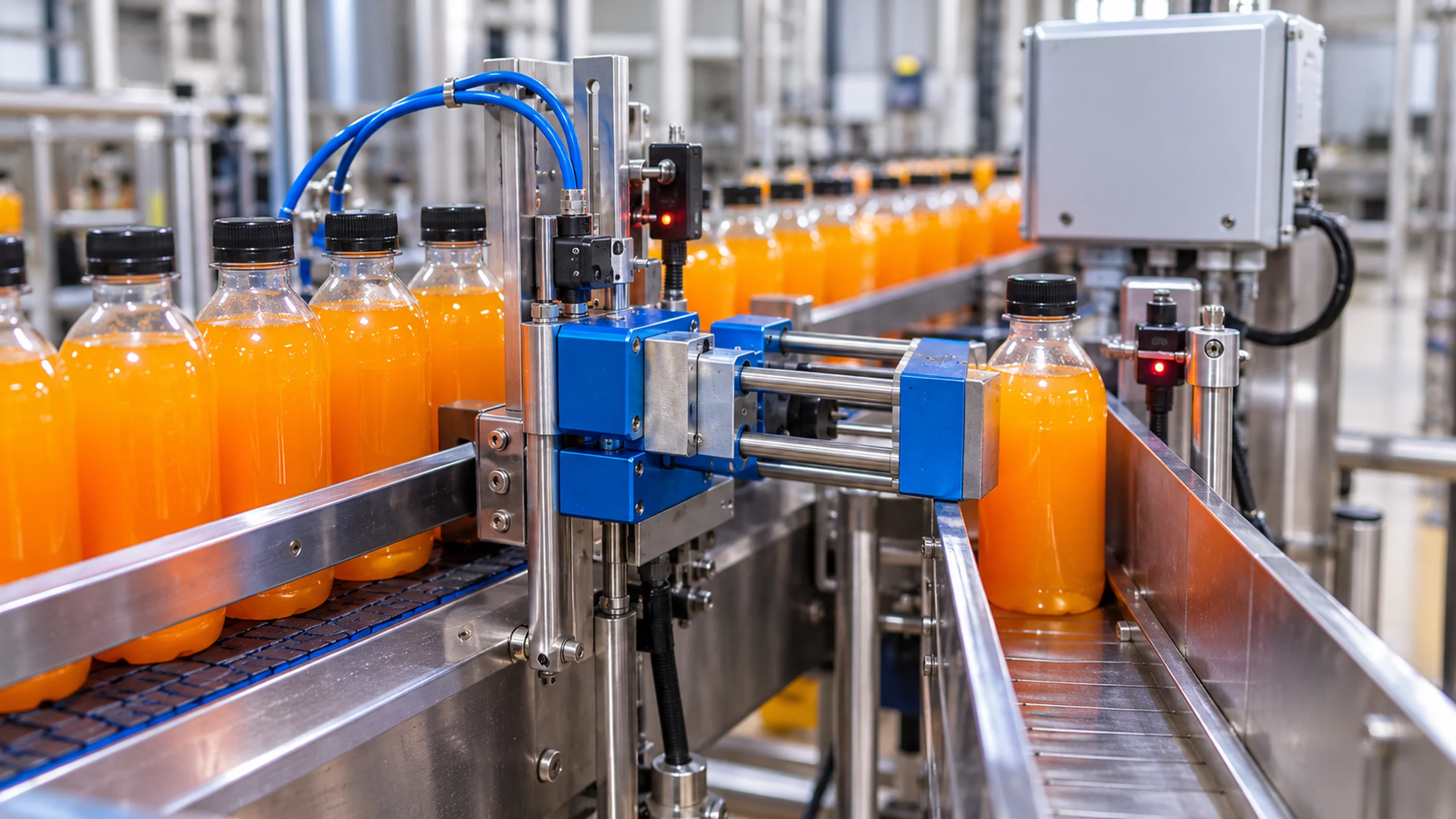
Physical AI can connect observations from a beverage production line to a defined equipment response. In a bottling or packaging operation, that may mean routing a flagged container to an inspection lane, requesting a controlled line stop, or adjusting a permitted operating parameter. The action path must identify the target equipment, confirm that the command is authorized, remain within site-approved limits, and verify the resulting physical state.
What authorized physical action means on a beverage line
For beverage manufacturers, relevant equipment can include bottle and can conveyors, filling and capping machines, labelers, case packers, palletizers, pumps, valves, and inspection or reject stations. The appropriate action depends on the process design and the authority assigned to the operator, programmable logic controller (PLC), supervisory control system, and connected applications.
Illustrative scenario: diverting a flagged bottle for inspection
Consider a packaged beverage line where an inspection camera identifies a bottle with a potentially incorrect label position or another packaging condition that requires review. The image result is associated with the bottle's position and the current line state. A decision workflow checks the inspection result, the applicable quality rule, the bottle's tracking context, and whether the downstream reject station is available.
If the required conditions are satisfied, the system can submit a bounded request to the line's approved control interface to divert the identified bottle to a designated inspection lane. The PLC and machine controls remain responsible for executing the validated motion sequence and enforcing equipment interlocks. The operator or quality technician can review the exception and determine the appropriate disposition.
From observation to an authorized command
A dependable action workflow preserves the relationship between the observed condition, the decision, the permission check, the equipment command, and the resulting state. Each stage should produce enough context for an operator or engineer to understand what was requested and what actually occurred.
1. Identify the target and establish current state
The system first associates the inspection result or process event with the correct container, package, conveyor zone, or machine. Inputs may include industrial cameras, photoelectric sensors, encoders, barcode or radio-frequency identification (RFID) reads, line-speed data, and PLC status. Timestamps and position estimates must be sufficiently current for the intended action. Missing, stale, duplicated, or conflicting observations should be treated as exceptions rather than silently accepted.
2. Evaluate the decision against operating constraints
The AI Decision Engine or rules-based logic evaluates the observation against the applicable quality criteria and current production context. Relevant constraints can include conveyor speed, spacing between containers, reject-bin capacity, downstream equipment availability, changeover state, product format, and whether the line is in automatic, manual, cleaning, or maintenance mode. The decision output should identify the proposed action, its target, the evidence used, and any uncertainty that requires human review.
3. Confirm authority before execution
The control path must check that the requesting application or user has permission for the specific action and equipment. Authorization should be scoped by asset, command type, operating mode, and permitted parameter range. A request to divert one identified bottle is different from a request to stop an entire packaging line or change a filler setpoint. Higher-impact actions may require an explicit operator approval or a separate production authorization.
4. Send the command through the approved interface
An approved gateway or integration service can pass a structured request to the relevant PLC, line controller, or machine interface. The request should include a unique command identifier, target, requested operation, validity period, and relevant process context. The receiving controller should validate the request against its own operating logic and return an acknowledgment, rejection, or fault status. The AI application should not bypass validated machine control or independent protective functions.
Equipment interfaces and beverage production dependencies
The physical action path depends on the equipment installed at the facility. A bottle-diversion application may use a pneumatic pusher, servo-driven guide, reject arm, or another manufacturer-approved mechanism. A controlled conveyor stop may use a variable-frequency drive (VFD) or motor starter through the line's established control architecture. The correct interface and sequence must be confirmed with the original equipment manufacturer (OEM), controls engineer, and plant engineering team.
Programmable logic controllers and line controllers: validate machine states, sequence timing, permissives, interlocks, and command acceptance.
Sensors and identification devices: provide container presence, position, spacing, speed, and identity evidence where required.
Actuators and drives: perform the permitted movement or speed change within equipment-specific limits.
Industrial gateways and edge devices: exchange approved data and commands between connected applications and operational technology (OT) networks.
Manufacturing execution and quality systems: preserve exception records, product context, operator disposition, and traceability where integration is available.
Integration with a manufacturing execution system (MES), supervisory control and data acquisition (SCADA) platform, enterprise resource planning (ERP) system, or quality management application should be designed around clear data ownership and interface contracts. The availability of a particular connector or control interface must be confirmed during site assessment.
Command execution, acknowledgment, and physical verification
A successful message exchange does not prove that the intended physical action occurred. The workflow should distinguish among a command being submitted, accepted by the controller, executed by the equipment, and confirmed by a subsequent observation. For a bottle-diversion example, verification could use a downstream photoeye, camera, encoder position, reject-lane sensor, or operator confirmation to establish whether the targeted bottle reached the expected location.
The system should compare the requested state with the observed state and record any mismatch. If a command is rejected, times out, or receives no valid completion evidence, the workflow should not report success. It should raise an exception, preserve the relevant event history, and follow the plant's approved fallback procedure.
Human oversight, protective controls, and fault handling
Human authority must be explicit. Plant personnel should know which actions are recommendations, which require approval, and which may run automatically within a narrowly defined operating envelope. Operators need a practical way to reject a request, take manual control, or stop an automated sequence according to site procedures.
Use role-based permissions and least-privilege access for operators, engineers, service personnel, and connected applications.
Define equipment-specific operating limits, permitted modes, command expiry, and conditions that require renewed authorization.
Retain validated machine guarding, emergency stops, safety interlocks, and independent safety functions. An AI decision layer is not a substitute for machinery safety engineering.
Reject commands when the target is ambiguous, the state data is stale, required sensors are unavailable, or the equipment is not in an approved mode.
Define safe behavior for communication loss, controller faults, actuator failure, jam conditions, and unavailable reject capacity.
Log the requesting identity, decision basis, approval, command identifier, controller response, observed outcome, and recovery action.
A communication failure should not cause an uncontrolled retry. Retries must be bounded and designed to avoid duplicate physical actions. Where the system cannot establish whether a command already occurred, it should stop automatic repetition and request a controlled reconciliation.
How to evaluate an authorized-action pilot
A pilot should begin with one well-defined beverage production task and a documented baseline. The initial scope may be limited to a simulated control interface, a test conveyor, or a supervised production trial after engineering and safety reviews. The objective is to test the complete observation-to-verification workflow, not simply whether an AI model can generate a recommendation.
Action authorization: percentage of requests correctly permitted or rejected under the defined policy.
Execution confirmation: percentage of accepted commands with independent evidence of the expected physical result.
Targeting and sequencing: incorrect target rate, missed diversion rate, duplicate-action rate, and sequencing errors.
Response performance: decision latency, command acknowledgment time, and end-to-end verification time under representative line speeds.
Exception handling: behavior during stale observations, missing sensor data, blocked reject lanes, actuator faults, and network interruption.
Operational impact: operator interventions, inspection workload, line disruption, product handling, and recovery time compared with the baseline.
Traceability: completeness of records linking the inspection event, authorization, command, controller response, and final disposition.
Test cases should cover normal operation and degraded conditions. Results should be reported with the equipment configuration, product format, line speed, test duration, and known limitations. A successful controlled demonstration does not establish suitability for every bottling line or production facility.
Implementation considerations for beverage manufacturers
Before connecting an AI-supported decision to production equipment, the project team should document the process boundary, target machine, permitted action, control owner, data sources, and expected fallback. Site assessment should include the OEM documentation, PLC program and interface constraints, network architecture, sanitation and washdown requirements, environmental conditions, and maintenance access.
A staged implementation can reduce risk: begin with read-only monitoring, validate event and state quality, introduce recommendations for operator review, and then assess a narrowly scoped authorized command in a controlled environment. Any move toward bounded autonomous execution should depend on documented acceptance criteria, equipment validation, cybersecurity review, and operational approval.
BeveragePro's Physical AI and AIoT approach is intended to frame these functions as connected stages: identify the relevant asset or product, sense its physical and process state, evaluate the situation, and connect an approved decision to a controlled action where the site supports it. Specific equipment compatibility, integration availability, and deployment readiness must be established for each application.
Discuss an authorized physical-action application
If your team is evaluating automated inspection response, bottle or case diversion, controlled conveyor actions, or another beverage production workflow, define the target equipment and the action that needs to be governed. Share the available sensor data, control interfaces, operating constraints, and approval process so the application can be assessed against the plant's requirements.